



ebookpremium
MyBoerse.bz Pro Member
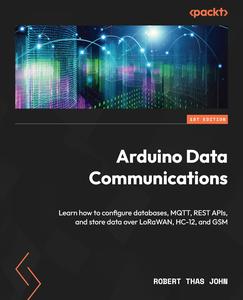
Free Download Arduino Data Communications
by Robert Thas John
English | 2023 | ISBN: 1837632618 | 286 pages | True PDF EPUB | 16.25 MB
Build real-world, scalable, and fault-tolerant IoT systems using Arduino MKR boards that collect, transmit, and store data on a massive scale in a structured database
Key Features
Set up databases to store and retrieve information collected from various sensors
Ingest your data into your database for storage with REST APIs and MQTT
Communicate with your application layer using different communication technologies from Arduino MKR and Portenta H7
Purchase of the print or Kindle book includes a free PDF eBook
Book Description
In our modern, internet-connected world, where billions of devices constantly collect and send data to systems to be stored and processed, it's surprising how the intricacies of data transmission and storage are often overlooked in the IoT domain. With Arduino Data Communications, you'll bridge the knowledge gap and become an expert in collecting data from IoT sensors, transmitting data, and configuring your own databases.
This book is an exploration of IoT's inner workings, guiding you through the process of setting up an end-to-end system that you can employ to prototype your own IoT solutions, using easy-to-follow examples. It begins with a general overview of the Arduino ecosystem, acquainting you with various sensors and shields and unveiling the art of data collection. You'll then explore data formats and methods to store data, both locally and on database servers. As you progress through the chapters, you'll learn how to set up REST and MQTT infrastructure to communicate with databases and get hands-on with LoRaWAN, Ethernet, cellular, HC-12, and RS-485. The final chapters are your training ground for real-world projects, imparting the essential knowledge you need to tackle complex challenges with confidence.
By the end of this Arduino book, you'll have seamlessly configured an end-to-end system, all while immersing yourself in practical scenarios that bring the world of IoT to life.
What you will learn
Explore data storage formats for both local and remote storage solutions
Build projects that leverage the variety of communication standards
Set up a database to host data transmitted from various projects
Use MQTT and RESTful APIs to send data from devices to remote systems
Prepare for multiple devices using high availability measures
Use LoRa by implementing a gateway and a client
Transmit temperature and humidity data over RS-485 and HC-12
Who this book is for
This book is for embedded systems engineers and electronics engineers who want to build IoT devices and gain insights into storing data collected from these devices, as well as establish communication between devices. The skills you learn in this book will come in handy even if your final product isn't built on Arduino. While prior experience with computers is assumed, expertise with embedded systems such as Arduino is not a prerequisite. Familiarity with Arduino programming will be beneficial, but not necessary.
Table of Contents
Getting Started with Arduino
Leveraging Various Sensors for Data Acquisition
Prototyping with Shields
Storing Data Collected from Sensors
Implementing REST and MQTT Protocols for Communication
Utilizing Various Communication Technologies
Communicating with LoRaWAN
Working with Ethernet
Leveraging Cellular Communication Technology
Communicating via HC-12
Managing Communication with RS-485
Enhancing Security for Reducing Risk
Scaling for High Availability
Building and Manufacturing Hardware
Links are Interchangeable - Single Extraction
