




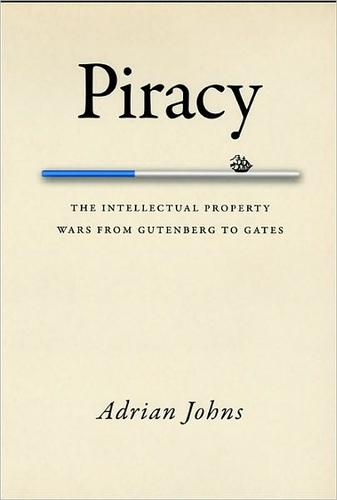
Title: Piracy: the intellectual property wars from Gutenberg to Gates
Author(s): Adrian Johns
Language: English
Publisher: University of Chicago Press
ISBN: 9780226401188
Extension: EPUB
Size: 5 MB
Subjects: History, General, United States, Language Arts & Disciplines, Europe, Piracy (Copyright), Publishing, Copyright, Intellectual property infringement - History, Civil Law, Piracy (Copyright) - History, Graphic Arts, Printing - History, Law, Intellectual History, Intellectual Property, Typography, Software piracy, Legal History, Printing, Software piracy - History, Copyright infringement, Business & Financial, Intellectual property infringement, Design, Copyright infringement - History
From Publishers Weekly
The recording industry's panic over illegal downloads is nothing new; a century ago, London publishers faced a similar crisis when pirate editions of sheet music were widely available at significantly less cost. Similarly, the debate over pharmaceutical patents echoes an 18th-century dispute over the origins of Epsom salt. These are just two of the historical examples that Johns (_The Nature of the Book_) draws upon as he traces the tensions between authorized and unauthorized producers and distributors of books, music, and other intellectual property in British and American culture from the 17th century to the present. Johns's history is liveliest when it is rooted in the personal-the 19th-century renegade bibliographer Samuel Egerton Brydges, for example, or the jazz and opera lovers who created a thriving network of bootleg recordings in the 1950s-but the shifting theoretical arguments about copyright and authorial property are presented in a cogent and accessible manner. Johns's research stands as an important reminder that today's intellectual property crises are not unprecedented, and offers a survey of potential approaches to a solution. 40 b&w illus. (Feb.)
Copyright © Reed Business Information, a division of Reed Elsevier Inc. All rights reserved.
Review
"In his invaluable book Piracy, Adrian Johns argues that the tendency of intellectual property battles to undermine privacy is not new. On the contrary, Johns . . . argues that ever since the medieval and Enlightenment eras, corporations have tried to defend their economic interests by searching for intellectual piracy in the private sphere of people''s homes. He says that all of our current debates about intellectual piracy-from Google''s efforts to create a universal digital library to the fight over how vigorous patents should be-have antecedents in the copyright wars of earlier eras."-Jeffrey Rosen, Washington Post
(Jeffrey Rosen Washington Post )
"It's easy to assume, amid all the brouhaha about intellectual property, illegal downloading, and the internet in general, that the question of piracy was born with the web browser. But as long as there have been ideas, people have been accused of stealing them. In this detail-packed biography of fakery, science historian Adrian Johns describes one of the earliest attempts to protect authors' rights-a vellum-bound book registry in the Stationer's Hall in 17th century London-and examines everything from the Victorian crusade against the patent, to the radio pirates of the 1920s, to the telephone phreakers of the 1970s and the computer hackers of today. Piracy is not new, he concludes, but we are due for a revolution in intellectual property, and science may be its ideal breeding ground."-_Seed_
(_Seed_ )
"While the rise of the Internet has given it new dimensions, the concept of intellectual piracy has existed for centuries, and the disputes of previous eras have much in common with those of our own time. In a new book, _Piracy, Adrian Johns details the long history of the term and its battles, arguing that those who would shape the future of intellectual property should first understand its past."-Inside Higher Education_
(_Inside Higher Education_ )
"Johns makes a bold claim: disputes over intellectual piracy have touched on so many crucial issues of creativity and commerce, identity and invention, science and society, that tracing them amounts to 'a history of modernity from askance.' . . . More generally, Piracy shows us how the very notion of intellectual property-and its sharp division into the fields of patent and copyright-was created in response to specific pressures and so could be modified dramatically or even abolished. . . . 'We are constantly trying to shoehorn problems into an intellectual framework designed 150 years ago in a different world.'"-Matthew Reisz, Times Higher Education
(_Times Higher Education_ )
"Adrian Johns argues that piracy is a cultural force that has driven the development of intellectual-property law, politics, and practices. As copying technologies have advanced, from the invention of printing in the sixteenth century to the present, acts of piracy have shaped endeavours from scientific publishing to pharmaceuticals and software. . . . Johns suggests, counter-intuitively, that piracy can promote the development of technology. The resulting competition forces legitimate innovators to manoeuvre for advantage-by moving quickly, using technical countermeasures or banding together and promoting reputation as an indicator of quality, such as through trademarks. . . . The exclusive rights granted by intellectual-property laws are always being reshaped by public opinion, and accused pirates have lobbied against these laws for centuries."-Michael Gollin, Nature
(Michael Gollin Nature )
Download Piracy The Intellectual Property Wars F - Adrian Johns
