• Regeln für den Video-Bereich:

    In den Börsenbereich gehören nur Angebote die bereits den Allgemeinen Regeln entsprechen.

    Einteilung

    - Folgende Formate gehören in die angegeben Bereiche:
    - Filme: Encodierte Filme von BluRay, DVD, R5, TV, Screener sowie Telesyncs im Format DivX, XviD und x264.
    - DVD: Filme im Format DVD5, DVD9 und HD2DVD.
    - HD: Encodierte Filme mit der Auflösung 720p oder darüber von BluRay, DVD, R5, TV, Screener sowie Telesyncs im Format x264.
    - 3D: Encodierte Filme von BluRay, die in einem 3D Format vorliegen. Dies gilt auch für Dokus, Animation usw.
    - Serien: Cartoon/Zeichentrick, Anime, Tutorials, Dokumentationen, Konzerte/Musik, Sonstiges sind demnach in die entsprechenden Bereiche einzuordnen, auch wenn sie beispielsweise im High Definition-Format oder als DVD5/DVD9/HD2DVD vorliegen. Ausnahme 3D.
    - Bereich Englisch: Englische Releases gehören immer in diesen Bereich.
    - Bereich Talk: Der Bereich, in dem über die Releases diskutiert werden kann, darf, soll und erwünscht ist.


    Angebot/Beitrag erstellen

    - Ein Beitrag darf erst dann erstellt werden, wenn der Upload bei mindestens einem OCH komplett ist. Platzhalter sind untersagt.
    - Bei einem Scenerelease hat der Threadtitel ausschließlich aus dem originalen, unveränderten Releasenamen zu bestehen. Es dürfen keine Veränderungen wie z.B. Sterne, kleine Buchstaben o.ä. vorgenommen werden. Ausnahme Serienbörse:
    - Bei einem Sammelthread für eine Staffel entfällt aus dem Releasename natürlich der Name der Folge. Beispiel: Die Simpsons S21 German DVDRip XviD - ITG
    - Dementsprechend sind also u.a. verboten: Erweiterungen wie "Tipp", "empfehlenswert", "only", "reup", usw. / jegliche andere Zusatzinformation oder Ergänzung, welche nicht in obiger Beschreibung zu finden ist.

    Aufbau des Angebots und Threadtitel

    Der Titel nach folgendem Muster erstellt zu werden. <Name> [3D] [Staffel] [German] <Jahr> <Tonspur> [DL] [Auflösung] <Quelle> <Codec> - <Group>
    Beispiel: The Dark Knight German 2008 AC3 DVDRip XviD - iND
    Beispiel: The Dark Knight 2008 DTS DL BDRip x264 - iND
    Beispiel: The Dark Knight 2008 AC3 DL BDRip XviD - iND
    Beispiel: The Dark Knight German 2008 AC3 720p BluRay x264 iND
    Beispiel: The Dark Knight 2008 DTS DL 1080p BluRay x264 iND
    Beispiel: Die Simpsons S01 German AC3 DVDRip XviD iND
    Beispiel: Die Simpsons S20 German AC3 720p BluRay x264 iND
    Beispiel: Sword Art Online II Ger Sub 2014 AAC 1080p WEBRip x264 - peppermint
    Entsprechend sind also u.a. verboten: Sonderzeichen wie Klammern, Sterne, Ausrufezeichen, Unterstriche, Anführungszeichen / Erweiterungen wie "Tipp", "empfehlenswert", "only", "reup", usw. / jegliche andere Zusatzinformation oder Ergänzung, welche nicht in obiger Beschreibung zu finden ist
    Ausnahmen hiervon können in den Bereichen geregelt sein.

    Die Beiträge sollen wie folgt aufgebaut werden:
    Überschrift entspricht dem Threadtitel
    Cover
    kurze Inhaltsbeschreibung
    Format, Größe, Dauer sind gut lesbar für Downloader außerhalb des Spoilers zu vermerken
    Nfo sind immer Anzugeben und selbige immer im Spoiler in Textform.
    Sind keine Nfo vorhanden z.B. Eigenpublikationen, sind im Spoiler folgende Dateiinformationen zusätzlich anzugeben :
    Quelle
    Video (Auflösung und Bitrate)
    Ton (Sprache, Format und Bitrate der einzelnen Spuren)
    Untertitel (sofern vorhanden)
    Hosterangabe in Textform außerhalb eines Spoiler mit allen enthaltenen Hostern.
    Bei SD kann auf diese zusätzlichen Dateiinformationen verzichtet werden.

    Alle benötigten Passwörter sind, sofern vorhanden, in Textform im Angebot anzugeben.
    Spoiler im Spoiler mit Kommentaren :"Schon Bedankt?" sind unerwünscht.


    Releases

    - Sind Retail-Release verfügbar, sind alle anderen Variationen untersagt. Ausnahmen: Alle deutschen Retail-Release sind CUT, in diesem Fall sind dubbed UNCUT-Release zulässig.
    - Im Serien-Bereich gilt speziell: Wenn ein Retail vor Abschluss einer laufenden Staffel erscheint, darf diese Staffel noch zu Ende gebracht werden.62
    - Gleiche Releases sind unbedingt zusammenzufassen. Das bedeutet, es ist zwingend erforderlich, vor dem Erstellen eines Themas per Suchfunktion zu überprüfen, ob bereits ein Beitrag mit demselben Release besteht. Ist dies der Fall, ist der bereits vorhandene Beitrag zu verwenden.
    - P2P und Scene Releases dürfen nicht verändert oder gar unter einem iND Tag eingestellt werden.


    Support, Diskussionen und Suche

    - Supportanfragen sind entweder per PN oder im Bereich Talk zu stellen.
    - Diskussionen und Bewertungen sind im Talk Bereich zu führen. Fragen an die Uploader haben ausschließlich via PN zu erfolgen, und sind in den Angeboten untersagt.
    - Anfragen zu Upload-Wünschen sind nur im Bereich Suche Video erlaubt. Antworten dürfen nur auf Angebote von MyBoerse.bz verlinkt werden.


    Verbote

    - Untersagt sind mehrere Formate in einem einzigen Angebotsthread, wie beispielsweise das gleichzeitige Anbieten von DivX/XviD, 720p und 1080p in einem Thread. Pro Format, Release und Auflösung ist ein eigener Thread zu eröffnen.
    - Grundsätzlich ebenso verboten sind Dupes. Uploader haben sich an geeigneter Stelle darüber zu informieren, ob es sich bei einem Release um ein Dupe handelt.
    - Gefakte, nur teilweise lauffähige oder unvollständige Angebote sind untersagt. Dies gilt auch für eigene Publikationen, die augenscheinlich nicht selbst von z.B. einer DVD gerippt wurden. Laufende Serien, bei denen noch nicht alle Folgen verfügbar sind, dürfen erstellt und regelmäßig geupdatet werden.
    - Untersagt sind Angebote, welche nur und ausschließlich in einer anderen Sprache als deutsch oder englisch vorliegen. Ausnahmen sind VORHER mit den Moderatoren zu klären.


    Verstoß gegen die Regeln

    - Angebote oder Beiträge, die gegen die Forenregeln verstoßen, sind über den "Melden"-Button im Beitrag zu melden.
  • Bitte registriere dich zunächst um Beiträge zu verfassen und externe Links aufzurufen.

++ Premium IPTV ++ 7000 Live Sender ++ UHD Qualität ++ Mediathek mit 18.000 Inhalten ++


VenneTV


4In1 Bundle: Mysql, Postgresql, Microsoft Sql & Oracle Sql

AgentofHeart

MyBoerse.bz Pro Member

fbf533ead8afb68e1c4ddb47d5ad3f4e.jpg

4-In-1 Bundle: Mysql, Postgresql, Microsoft Sql & Oracle Sql
Published 12/2022
MP4 | Video: h264, 1280x720 | Audio: AAC, 44.1 KHz
Language: English | Size: 6.51 GB | Duration: 14h 56m​

Learn concepts & compare syntax of 4 popular SQL dialects- PostgreSQL, MySQL, Microsoft SQL & Oracle SQL | SQL Bundle

What you'll learn

How to write SELECT queries to fetch relevant data in 4 SQL dialects - PostgreSQl, MySQL, Oracle SQL and Microsoft SQL

How to filter and sort the data using WHEN, logical operators and ORDER BY

How to group and aggregate data in PostgreSQl, MySQL, Oracle SQL and Microsoft SQL

How to apply joins and combining queries in 4 SQL dialects - PostgreSQl, MySQL, Oracle SQL and Microsoft SQL

String, mathematical, date-time functions and pattern matching in 4 SQL dialects - PostgreSQl, MySQL, Oracle SQL and Microsoft SQL

Understanding of VIEWS and INDEXES in 4 SQL dialects - PostgreSQl, MySQL, Oracle SQL and Microsoft SQL

How to write subqueries in SQL

Requirements

Just a PC with any web browser

Description

4 Reasons why you should choose this SQL bundleCarefully designed curriculum teaching you everything in SQL that you will need for Data analysis in businessesComprehensive - covers basic and advanced SQL statements in top 4 SQL dialects, MySQL, PostgreSQL, MS SQL and Oracle SQLDownloadable resources covering essential topics on SQLYour queries on SQL and anything covered in the Masterclass will be responded by the Instructor himselfA Verifiable Certificate of Completion is presented to all students who undertake this SQL course.Why should you choose this course?This is a complete tutorial on SQL which can be completed within a week. SQL is the most sought-after skill for Data analysis roles in all the companies. MySQL, PostgreSQL, MS SQL and Oracle SQL are highly desired skills for database management and data analysis roles. So whether you want to start a career as a data scientist or just grow you data analysis skills, this course will cover everything you need to know to do that.What makes us qualified to teach you?The course is taught by Abhishek, Pukhraj and Nadeem. Instructors of the course have been teaching Data Science and Machine Learning for over a decade. They have an in-depth knowledge in advanced SQL, PostgreSQL, Oracle SQL, database management, and various data analysis tools available in the market.Our PromiseTeaching our students is our job and we are committed to it. If you have any questions about the course content, practice sheet or anything related to any topic, you can always post a question in the course or send us a direct message.By the end of this course, your confidence in using SQL will soar. You'll have a thorough understanding of how to use SQL for Data analytics as a career opportunity.Go ahead and click the enroll button, and I'll see you in lesson 1!CheersStart-Tech AcademyFAQ'sWhy learn SQL?SQL is the most universal and commonly used database language. It powers the most commonly used database engines like MySQL, PostgreSQL, Oracle SQL, and Microsoft SQL. Simply put, If you want to access databases then yes, you need to know SQL.It is not really difficult to learn SQL. SQL is not a programming language, it's a query language. The primary objective where SQL was created was to give the possibility to common people to get interesting data from the database. It is also an English-like language so anyone who can use English at a basic level can write SQL queries easily.SQL is one of the most sought-after skills by hiring employers.You can earn good moneyHow much time does it take to learn SQL?SQL is easy but no one can determine the learning time it takes. It totally depends on you. The method we adopted to help you learn SQL quickly starts from the basics and takes you to advanced level within hours. You can follow the same, but remember you can learn nothing without practicing it. Practice is the only way to learn SQL quickly.What's the difference between SQL and PostgreSQL?SQL is a language. Specifically, the "Structured Query Language"PostgreSQL is one of several database systems, or RDMS (Relational Database Management System). PostgresSQL is one of several RDMS's, others of which are Oracle, Informix, MySQL, and MSQL.All of these RDMSs use SQL as their language. Each of them has minor variations in the "dialect" of SQL that they use, but it's all still SQL.Who uses these databases?Here are a few examples of companies that use PostgreSQL: Apple, BioPharm, Etsy, IMDB, Macworld, Debian, Fujitsu, Red Hat, Sun Microsystem, Cisco, Skype.Companies that use MySQL: Uber, Airbnb, Netflix, Udemy, Pinterest etc.Companies that use Oracle SQL: Gartner, Nike, Costco, eBay etc.Companies that use MS SQL: Accenture, Cognizant, Dell, Microsoft, ViaVarejo etc.

Overview

Section 1: Introduction

Lecture 1 Introduction

Section 2: Course Resources

Lecture 2 Course resources

Lecture 3 This is a milestone!

Section 3: Setting up PostgreSQL and PGAdmin

Lecture 4 Installing PostgreSQL and PGAdmin in your PC

Lecture 5 If pgAdmin is not opening.

Section 4: Installing MySQL

Lecture 6 Installing and Setting up MySQL

Section 5: Installing MS SQL

Lecture 7 Installing and Setting up MS SQL

Section 6: Installing Oracle SQL

Lecture 8 Installing and Setting up Oracle SQL

Section 7: Fundamental SQL statements

Lecture 9 CREATE in PostgreSQL

Lecture 10 CREATE in MySQL

Lecture 11 CREATE in MS SQL

Lecture 12 CREATE in OracleSQL

Lecture 13 INSERT in PostgreSQL

Lecture 14 INSERT in MySQL

Lecture 15 INSERT in MS SQL

Lecture 16 INSERT in Oracle SQL

Lecture 17 Import data from File in PostgreSQL

Lecture 18 Import data from File in MySQL

Lecture 19 Import data from File in MS SQL

Lecture 20 Import data from File in Oracle SQL

Lecture 21 SELECT statement in PostgreSQL

Lecture 22 SELECT statement in MySQL

Lecture 23 SELECT statement in MS SQL

Lecture 24 SELECT statement in Oracle SQL

Lecture 25 SELECT DISTINCT in PostgreSQL

Lecture 26 SELECT DISTINCT in MySQL

Lecture 27 SELECT DISTINCT in MS SQL

Lecture 28 SELECT DISTINCT in Oracle SQL

Lecture 29 WHERE in PostgreSQL

Lecture 30 WHERE in MySQL

Lecture 31 WHERE in MS SQL

Lecture 32 WHERE in Oracle SQL

Lecture 33 Logical Operators in PostgreSQL

Lecture 34 Logical Operators in MySQL

Lecture 35 Logical Operators in MS SQL

Lecture 36 Logical Operators in Oracle SQL

Lecture 37 UPDATE in PostgreSQL

Lecture 38 UPDATE in MySQL

Lecture 39 UPDATE in MS SQL

Lecture 40 UPDATE in Oracle SQL

Lecture 41 DELETE in PostgreSQL

Lecture 42 DELETE in MySQL

Lecture 43 DELETE in MS SQL

Lecture 44 DELETE in Oracle SQL

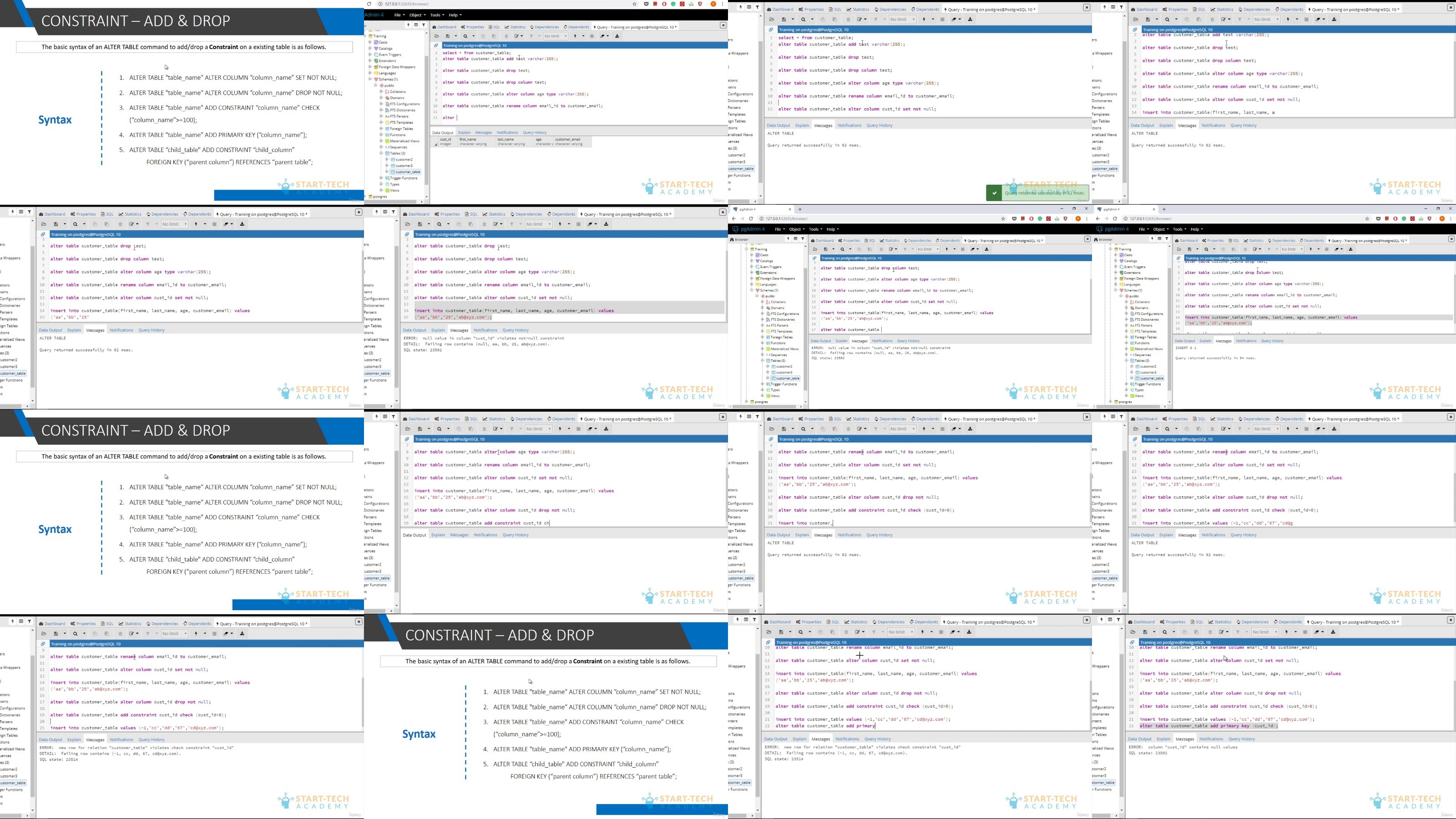
Lecture 45 ALTER Part 1 in PostgreSQL

Lecture 46 ALTER Part 2 in PostgreSQL

Lecture 47 ALTER in MySQL

Lecture 48 ALTER in MS SQL

Lecture 49 ALTER in Oracle SQL

Section 8: Restore and Back-up in PostgreSQL

Lecture 50 Restore and Back-up

Lecture 51 Debugging restoration issues

Lecture 52 Creating DB using CSV files

Lecture 53 Debugging summary and Code for CSV files

Section 9: Restore and Back-up in MySQL

Lecture 54 Restoring and Back-up in MySQL

Lecture 55 Restore and Back-up in MySQL

Section 10: Restore and Back-up in MS SQL

Lecture 56 Restoring and Back-up in MS SQL

Lecture 57 Restoring and Back-up in MS SQL

Section 11: Restore and Back-up in Oracle SQL

Lecture 58 Restoring and Back-up in Oracle SQL

Section 12: Selection commands: Filteing

Lecture 59 IN in PostgreSQL

Lecture 60 IN in MySQL

Lecture 61 IN in MS SQL

Lecture 62 BETWEEN in PostgreSQL

Lecture 63 BETWEEN in MySQL

Lecture 64 BETWEEN in MS SQL

Lecture 65 IN & BETWEEN in Oracle SQL

Lecture 66 LIKE in PostgreSQL

Lecture 67 LIKE in MySQL

Lecture 68 LIKE in MS SQL

Lecture 69 LIKE in Oracle SQL

Section 13: Selection commands: Ordering

Lecture 70 Side Lecture: Commenting in SQL

Lecture 71 ORDER BY in PostgreSQL

Lecture 72 ORDER BY in MySQL

Lecture 73 ORDER BY in MS SQL

Lecture 74 LIMIT in PostgreSQL

Lecture 75 LIMIT in MySQL

Lecture 76 LIMIT in MS SQL

Lecture 77 ORDER BY & LIMIT in Oracle SQL

Section 14: Aliases

Lecture 78 AS in PostgreSQL

Lecture 79 AS in MySQL

Lecture 80 AS in MS SQL

Lecture 81 AS in Oracle SQL

Section 15: Aggregate Commands

Lecture 82 COUNT in PostgreSQL

Lecture 83 COUNT in MySQL

Lecture 84 SUM in PostgreSQL

Lecture 85 SUM in MySQL

Lecture 86 AVERAGE in PostgreSQL

Lecture 87 AVERAGE in MySQL

Lecture 88 MIN & MAX in PostgreSQL

Lecture 89 MIN & MAX in MySQL

Lecture 90 Aggregate Functions in MS SQL

Lecture 91 Aggregate Functions in Oracle SQL

Section 16: Group By Commands

Lecture 92 GROUP BY in PostgreSQL

Lecture 93 GROUP BY in MySQL

Lecture 94 GROUP BY in MS SQL

Lecture 95 HAVING in PostgreSQL

Lecture 96 HAVING in MySQL

Lecture 97 HAVING in MS SQL

Lecture 98 GROUP BY & HAVING in Oracle SQL

Section 17: Conditional Statement

Lecture 99 CASE WHEN in PostgreSQL

Lecture 100 CASE WHEN in MySQL

Lecture 101 CASE WHEN in MS SQL

Lecture 102 CASE WHEN in Oracle SQL

Section 18: JOINS

Lecture 103 Introduction to Joins

Lecture 104 Concepts of Joining and Combining Data

Lecture 105 Preparing the data

Lecture 106 Inner Join in PostgreSQL

Lecture 107 Inner Join in MySQL

Lecture 108 Inner Join in MS SQL

Lecture 109 Inner Join in Oracle SQL

Lecture 110 Left Join in PostgreSQL

Lecture 111 Left Join in MySQL

Lecture 112 Left Join in MS SQL

Lecture 113 Right Join in PostgreSQL

Lecture 114 Right Join in MySQL

Lecture 115 Right Join in MS SQL

Lecture 116 Full Outer Join in PostgreSQL

Lecture 117 Full Outer Join in MySQL

Lecture 118 Full Outer Join in MS SQL

Lecture 119 Left, Right & Full Outer Join in Oracle SQL

Lecture 120 Cross Join in PostgreSQL

Lecture 121 Cross Join in MySQL

Lecture 122 Cross Join in MS SQL

Lecture 123 Cross Join in Oracle SQL

Lecture 124 Intersect and Intersect ALL in PostgreSQL

Lecture 125 Intersect in MySQL

Lecture 126 Except in PostgreSQL

Lecture 127 Except in MySQL

Lecture 128 Union in PostgreSQL

Lecture 129 Union in MySQL

Lecture 130 Intersect, Except & Union in MS SQL

Section 19: Subqueries

Lecture 131 Subqueries: Subquery in WHERE clause in PostgreSQL

Lecture 132 Subqueries: Subquery in FROM clause in PostgreSQL

Lecture 133 Subqueries: Subquery in SELECT in PostgreSQL

Lecture 134 Subqueries in MySQL

Lecture 135 Subqueries in MS SQL

Lecture 136 Subqueries in Oracle SQL

Section 20: Views and Indexes

Lecture 137 VIEWS in PostgreSQL

Lecture 138 VIEWS in MySQL

Lecture 139 VIEWS in MS SQL

Lecture 140 VIEWS in Oracle SQL

Lecture 141 INDEX in PostgreSQL

Lecture 142 INDEX in MySQL

Lecture 143 INDEX in MS SQL

Lecture 144 INDEX in Oracle SQL

Section 21: String Functions

Lecture 145 LENGTH in PostgreSQL

Lecture 146 LENGTH in Oracle SQL

Lecture 147 UPPER LOWER in PostgreSQL

Lecture 148 UPPER LOWER in Oracle SQL

Lecture 149 REPLACE in PostgreSQL

Lecture 150 REPLACE in Oracle SQL

Lecture 151 TRIM, LTRIM, RTRIM in PostgreSQL

Lecture 152 TRIM, LTRIM, RTRIM in Oracle SQL

Lecture 153 CONCATENATION in PostgreSQL

Lecture 154 CONCATENATION in Oracle SQL

Lecture 155 SUBSTRING in PostgreSQL

Lecture 156 SUBSTRING in Oracle SQL

Lecture 157 LIST AGGREGATION in PostgreSQL

Lecture 158 LIST AGGREGATION in Oracle SQL

Lecture 159 String Functions Part 1 in MySQL

Lecture 160 String Functions Part 2 in MySQL

Lecture 161 String Functions in MS SQL

Section 22: Mathematical Functions

Lecture 162 CEIL & FLOOR in PostgreSQL

Lecture 163 RANDOM in PostgreSQL

Lecture 164 SETSEED in PostgreSQL

Lecture 165 ROUND in PostgreSQL

Lecture 166 POWER in PostgreSQL

Lecture 167 Mathematical Functions in MySQL

Lecture 168 Mathematical Functions in MS SQL- Part 1

Lecture 169 Mathematical Functions in MS SQL- Part 2

Lecture 170 Mathematical Functions in Oracle SQL

Section 23: Date-Time Functions

Lecture 171 CURRENT DATE & TIME in PostgreSQL

Lecture 172 AGE in PostgreSQL

Lecture 173 EXTRACT in PostgreSQL

Lecture 174 Date-Time Functions in MySQL

Lecture 175 Date-Time Functions in MS SQL

Lecture 176 Date-Time Function in Oracle SQL

Lecture 177 Extract in Oracle SQL

Section 24: Data type conversion

Lecture 178 Data Type conversion to string in PostgreSQL

Lecture 179 Data Type conversion to Number and Date in PostgreSQL

Lecture 180 Data Type conversion in MySQL

Lecture 181 Data Type conversion in MS SQL

Section 25: PATTERN (STRING) MATCHING

Lecture 182 PATTERN MATCHING BASICS

Lecture 183 Advanced pattern matching Part 1 (REGULAR EXPRESSIONS)

Lecture 184 Advanced pattern matching Part 2 (REGULAR EXPRESSIONS)

Lecture 185 Pattern matching in MySQL

Lecture 186 Pattern matching in MS SQL

Lecture 187 Pattern matching in Oracle SQL

Section 26: Congratulations

Lecture 188 The final milestone!

Lecture 189 Bonus Lecture

Working Professionals beginning their Data journey,Anyone curious to learn and compare syntax in 4 SQL dialects - PostgreSQl, MySQL, Oracle SQL and Microsoft SQL,Students about to join their first corporate job
IyapPPrD_o.jpg


ab20340feafe92190566929cf531be70.jpg

4-In-1 Bundle: Mysql, Postgresql, Microsoft Sql & Oracle Sql
Published 12/2022
MP4 | Video: h264, 1280x720 | Audio: AAC, 44.1 KHz
Language: English | Size: 6.51 GB | Duration: 14h 56m​

Learn concepts & compare syntax of 4 popular SQL dialects- PostgreSQL, MySQL, Microsoft SQL & Oracle SQL | SQL Bundle

What you'll learn

How to write SELECT queries to fetch relevant data in 4 SQL dialects - PostgreSQl, MySQL, Oracle SQL and Microsoft SQL

How to filter and sort the data using WHEN, logical operators and ORDER BY

How to group and aggregate data in PostgreSQl, MySQL, Oracle SQL and Microsoft SQL

How to apply joins and combining queries in 4 SQL dialects - PostgreSQl, MySQL, Oracle SQL and Microsoft SQL

String, mathematical, date-time functions and pattern matching in 4 SQL dialects - PostgreSQl, MySQL, Oracle SQL and Microsoft SQL

Understanding of VIEWS and INDEXES in 4 SQL dialects - PostgreSQl, MySQL, Oracle SQL and Microsoft SQL

How to write subqueries in SQL

Requirements

Just a PC with any web browser

Description

4 Reasons why you should choose this SQL bundleCarefully designed curriculum teaching you everything in SQL that you will need for Data analysis in businessesComprehensive - covers basic and advanced SQL statements in top 4 SQL dialects, MySQL, PostgreSQL, MS SQL and Oracle SQLDownloadable resources covering essential topics on SQLYour queries on SQL and anything covered in the Masterclass will be responded by the Instructor himselfA Verifiable Certificate of Completion is presented to all students who undertake this SQL course.Why should you choose this course?This is a complete tutorial on SQL which can be completed within a week. SQL is the most sought-after skill for Data analysis roles in all the companies. MySQL, PostgreSQL, MS SQL and Oracle SQL are highly desired skills for database management and data analysis roles. So whether you want to start a career as a data scientist or just grow you data analysis skills, this course will cover everything you need to know to do that.What makes us qualified to teach you?The course is taught by Abhishek, Pukhraj and Nadeem. Instructors of the course have been teaching Data Science and Machine Learning for over a decade. They have an in-depth knowledge in advanced SQL, PostgreSQL, Oracle SQL, database management, and various data analysis tools available in the market.Our PromiseTeaching our students is our job and we are committed to it. If you have any questions about the course content, practice sheet or anything related to any topic, you can always post a question in the course or send us a direct message.By the end of this course, your confidence in using SQL will soar. You'll have a thorough understanding of how to use SQL for Data analytics as a career opportunity.Go ahead and click the enroll button, and I'll see you in lesson 1!CheersStart-Tech AcademyFAQ'sWhy learn SQL?SQL is the most universal and commonly used database language. It powers the most commonly used database engines like MySQL, PostgreSQL, Oracle SQL, and Microsoft SQL. Simply put, If you want to access databases then yes, you need to know SQL.It is not really difficult to learn SQL. SQL is not a programming language, it's a query language. The primary objective where SQL was created was to give the possibility to common people to get interesting data from the database. It is also an English-like language so anyone who can use English at a basic level can write SQL queries easily.SQL is one of the most sought-after skills by hiring employers.You can earn good moneyHow much time does it take to learn SQL?SQL is easy but no one can determine the learning time it takes. It totally depends on you. The method we adopted to help you learn SQL quickly starts from the basics and takes you to advanced level within hours. You can follow the same, but remember you can learn nothing without practicing it. Practice is the only way to learn SQL quickly.What's the difference between SQL and PostgreSQL?SQL is a language. Specifically, the "Structured Query Language"PostgreSQL is one of several database systems, or RDMS (Relational Database Management System). PostgresSQL is one of several RDMS's, others of which are Oracle, Informix, MySQL, and MSQL.All of these RDMSs use SQL as their language. Each of them has minor variations in the "dialect" of SQL that they use, but it's all still SQL.Who uses these databases?Here are a few examples of companies that use PostgreSQL: Apple, BioPharm, Etsy, IMDB, Macworld, Debian, Fujitsu, Red Hat, Sun Microsystem, Cisco, Skype.Companies that use MySQL: Uber, Airbnb, Netflix, Udemy, Pinterest etc.Companies that use Oracle SQL: Gartner, Nike, Costco, eBay etc.Companies that use MS SQL: Accenture, Cognizant, Dell, Microsoft, ViaVarejo etc.

Overview

Section 1: Introduction

Lecture 1 Introduction

Section 2: Course Resources

Lecture 2 Course resources

Lecture 3 This is a milestone!

Section 3: Setting up PostgreSQL and PGAdmin

Lecture 4 Installing PostgreSQL and PGAdmin in your PC

Lecture 5 If pgAdmin is not opening.

Section 4: Installing MySQL

Lecture 6 Installing and Setting up MySQL

Section 5: Installing MS SQL

Lecture 7 Installing and Setting up MS SQL

Section 6: Installing Oracle SQL

Lecture 8 Installing and Setting up Oracle SQL

Section 7: Fundamental SQL statements

Lecture 9 CREATE in PostgreSQL

Lecture 10 CREATE in MySQL

Lecture 11 CREATE in MS SQL

Lecture 12 CREATE in OracleSQL

Lecture 13 INSERT in PostgreSQL

Lecture 14 INSERT in MySQL

Lecture 15 INSERT in MS SQL

Lecture 16 INSERT in Oracle SQL

Lecture 17 Import data from File in PostgreSQL

Lecture 18 Import data from File in MySQL

Lecture 19 Import data from File in MS SQL

Lecture 20 Import data from File in Oracle SQL

Lecture 21 SELECT statement in PostgreSQL

Lecture 22 SELECT statement in MySQL

Lecture 23 SELECT statement in MS SQL

Lecture 24 SELECT statement in Oracle SQL

Lecture 25 SELECT DISTINCT in PostgreSQL

Lecture 26 SELECT DISTINCT in MySQL

Lecture 27 SELECT DISTINCT in MS SQL

Lecture 28 SELECT DISTINCT in Oracle SQL

Lecture 29 WHERE in PostgreSQL

Lecture 30 WHERE in MySQL

Lecture 31 WHERE in MS SQL

Lecture 32 WHERE in Oracle SQL

Lecture 33 Logical Operators in PostgreSQL

Lecture 34 Logical Operators in MySQL

Lecture 35 Logical Operators in MS SQL

Lecture 36 Logical Operators in Oracle SQL

Lecture 37 UPDATE in PostgreSQL

Lecture 38 UPDATE in MySQL

Lecture 39 UPDATE in MS SQL

Lecture 40 UPDATE in Oracle SQL

Lecture 41 DELETE in PostgreSQL

Lecture 42 DELETE in MySQL

Lecture 43 DELETE in MS SQL

Lecture 44 DELETE in Oracle SQL

Lecture 45 ALTER Part 1 in PostgreSQL

Lecture 46 ALTER Part 2 in PostgreSQL

Lecture 47 ALTER in MySQL

Lecture 48 ALTER in MS SQL

Lecture 49 ALTER in Oracle SQL

Section 8: Restore and Back-up in PostgreSQL

Lecture 50 Restore and Back-up

Lecture 51 Debugging restoration issues

Lecture 52 Creating DB using CSV files

Lecture 53 Debugging summary and Code for CSV files

Section 9: Restore and Back-up in MySQL

Lecture 54 Restoring and Back-up in MySQL

Lecture 55 Restore and Back-up in MySQL

Section 10: Restore and Back-up in MS SQL

Lecture 56 Restoring and Back-up in MS SQL

Lecture 57 Restoring and Back-up in MS SQL

Section 11: Restore and Back-up in Oracle SQL

Lecture 58 Restoring and Back-up in Oracle SQL

Section 12: Selection commands: Filteing

Lecture 59 IN in PostgreSQL

Lecture 60 IN in MySQL

Lecture 61 IN in MS SQL

Lecture 62 BETWEEN in PostgreSQL

Lecture 63 BETWEEN in MySQL

Lecture 64 BETWEEN in MS SQL

Lecture 65 IN & BETWEEN in Oracle SQL

Lecture 66 LIKE in PostgreSQL

Lecture 67 LIKE in MySQL

Lecture 68 LIKE in MS SQL

Lecture 69 LIKE in Oracle SQL

Section 13: Selection commands: Ordering

Lecture 70 Side Lecture: Commenting in SQL

Lecture 71 ORDER BY in PostgreSQL

Lecture 72 ORDER BY in MySQL

Lecture 73 ORDER BY in MS SQL

Lecture 74 LIMIT in PostgreSQL

Lecture 75 LIMIT in MySQL

Lecture 76 LIMIT in MS SQL

Lecture 77 ORDER BY & LIMIT in Oracle SQL

Section 14: Aliases

Lecture 78 AS in PostgreSQL

Lecture 79 AS in MySQL

Lecture 80 AS in MS SQL

Lecture 81 AS in Oracle SQL

Section 15: Aggregate Commands

Lecture 82 COUNT in PostgreSQL

Lecture 83 COUNT in MySQL

Lecture 84 SUM in PostgreSQL

Lecture 85 SUM in MySQL

Lecture 86 AVERAGE in PostgreSQL

Lecture 87 AVERAGE in MySQL

Lecture 88 MIN & MAX in PostgreSQL

Lecture 89 MIN & MAX in MySQL

Lecture 90 Aggregate Functions in MS SQL

Lecture 91 Aggregate Functions in Oracle SQL

Section 16: Group By Commands

Lecture 92 GROUP BY in PostgreSQL

Lecture 93 GROUP BY in MySQL

Lecture 94 GROUP BY in MS SQL

Lecture 95 HAVING in PostgreSQL

Lecture 96 HAVING in MySQL

Lecture 97 HAVING in MS SQL

Lecture 98 GROUP BY & HAVING in Oracle SQL

Section 17: Conditional Statement

Lecture 99 CASE WHEN in PostgreSQL

Lecture 100 CASE WHEN in MySQL

Lecture 101 CASE WHEN in MS SQL

Lecture 102 CASE WHEN in Oracle SQL

Section 18: JOINS

Lecture 103 Introduction to Joins

Lecture 104 Concepts of Joining and Combining Data

Lecture 105 Preparing the data

Lecture 106 Inner Join in PostgreSQL

Lecture 107 Inner Join in MySQL

Lecture 108 Inner Join in MS SQL

Lecture 109 Inner Join in Oracle SQL

Lecture 110 Left Join in PostgreSQL

Lecture 111 Left Join in MySQL

Lecture 112 Left Join in MS SQL

Lecture 113 Right Join in PostgreSQL

Lecture 114 Right Join in MySQL

Lecture 115 Right Join in MS SQL

Lecture 116 Full Outer Join in PostgreSQL

Lecture 117 Full Outer Join in MySQL

Lecture 118 Full Outer Join in MS SQL

Lecture 119 Left, Right & Full Outer Join in Oracle SQL

Lecture 120 Cross Join in PostgreSQL

Lecture 121 Cross Join in MySQL

Lecture 122 Cross Join in MS SQL

Lecture 123 Cross Join in Oracle SQL

Lecture 124 Intersect and Intersect ALL in PostgreSQL

Lecture 125 Intersect in MySQL

Lecture 126 Except in PostgreSQL

Lecture 127 Except in MySQL

Lecture 128 Union in PostgreSQL

Lecture 129 Union in MySQL

Lecture 130 Intersect, Except & Union in MS SQL

Section 19: Subqueries

Lecture 131 Subqueries: Subquery in WHERE clause in PostgreSQL

Lecture 132 Subqueries: Subquery in FROM clause in PostgreSQL

Lecture 133 Subqueries: Subquery in SELECT in PostgreSQL

Lecture 134 Subqueries in MySQL

Lecture 135 Subqueries in MS SQL

Lecture 136 Subqueries in Oracle SQL

Section 20: Views and Indexes

Lecture 137 VIEWS in PostgreSQL

Lecture 138 VIEWS in MySQL

Lecture 139 VIEWS in MS SQL

Lecture 140 VIEWS in Oracle SQL

Lecture 141 INDEX in PostgreSQL

Lecture 142 INDEX in MySQL

Lecture 143 INDEX in MS SQL

Lecture 144 INDEX in Oracle SQL

Section 21: String Functions

Lecture 145 LENGTH in PostgreSQL

Lecture 146 LENGTH in Oracle SQL

Lecture 147 UPPER LOWER in PostgreSQL

Lecture 148 UPPER LOWER in Oracle SQL

Lecture 149 REPLACE in PostgreSQL

Lecture 150 REPLACE in Oracle SQL

Lecture 151 TRIM, LTRIM, RTRIM in PostgreSQL

Lecture 152 TRIM, LTRIM, RTRIM in Oracle SQL

Lecture 153 CONCATENATION in PostgreSQL

Lecture 154 CONCATENATION in Oracle SQL

Lecture 155 SUBSTRING in PostgreSQL

Lecture 156 SUBSTRING in Oracle SQL

Lecture 157 LIST AGGREGATION in PostgreSQL

Lecture 158 LIST AGGREGATION in Oracle SQL

Lecture 159 String Functions Part 1 in MySQL

Lecture 160 String Functions Part 2 in MySQL

Lecture 161 String Functions in MS SQL

Section 22: Mathematical Functions

Lecture 162 CEIL & FLOOR in PostgreSQL

Lecture 163 RANDOM in PostgreSQL

Lecture 164 SETSEED in PostgreSQL

Lecture 165 ROUND in PostgreSQL

Lecture 166 POWER in PostgreSQL

Lecture 167 Mathematical Functions in MySQL

Lecture 168 Mathematical Functions in MS SQL- Part 1

Lecture 169 Mathematical Functions in MS SQL- Part 2

Lecture 170 Mathematical Functions in Oracle SQL

Section 23: Date-Time Functions

Lecture 171 CURRENT DATE & TIME in PostgreSQL

Lecture 172 AGE in PostgreSQL

Lecture 173 EXTRACT in PostgreSQL

Lecture 174 Date-Time Functions in MySQL

Lecture 175 Date-Time Functions in MS SQL

Lecture 176 Date-Time Function in Oracle SQL

Lecture 177 Extract in Oracle SQL

Section 24: Data type conversion

Lecture 178 Data Type conversion to string in PostgreSQL

Lecture 179 Data Type conversion to Number and Date in PostgreSQL

Lecture 180 Data Type conversion in MySQL

Lecture 181 Data Type conversion in MS SQL

Section 25: PATTERN (STRING) MATCHING

Lecture 182 PATTERN MATCHING BASICS

Lecture 183 Advanced pattern matching Part 1 (REGULAR EXPRESSIONS)

Lecture 184 Advanced pattern matching Part 2 (REGULAR EXPRESSIONS)

Lecture 185 Pattern matching in MySQL

Lecture 186 Pattern matching in MS SQL

Lecture 187 Pattern matching in Oracle SQL

Section 26: Congratulations

Lecture 188 The final milestone!

Lecture 189 Bonus Lecture

Working Professionals beginning their Data journey,Anyone curious to learn and compare syntax in 4 SQL dialects - PostgreSQl, MySQL, Oracle SQL and Microsoft SQL,Students about to join their first corporate job

3JMGk7Vs_o.jpg


e790155caba1afda47763a70664c81fb.jpg

4-In-1 Bundle: Mysql, Postgresql, Microsoft Sql & Oracle Sql
Last updated 9/2024
MP4 | Video: h264, 1280x720 | Audio: AAC, 44.1 KHz
Language: English (US) | Size: 3.57 GB | Duration: 15h 31m​

What you'll learn
How to write SELECT queries to fetch relevant data in 4 SQL dialects - PostgreSQl, MySQL, Oracle SQL and Microsoft SQL
How to filter and sort the data using WHEN, logical operators and ORDER BY
How to group and aggregate data in PostgreSQl, MySQL, Oracle SQL and Microsoft SQL
How to apply joins and combining queries in 4 SQL dialects - PostgreSQl, MySQL, Oracle SQL and Microsoft SQL
String, mathematical, date-time functions and pattern matching in 4 SQL dialects - PostgreSQl, MySQL, Oracle SQL and Microsoft SQL
Understanding of VIEWS and INDEXES in 4 SQL dialects - PostgreSQl, MySQL, Oracle SQL and Microsoft SQL
How to write subqueries in SQL

Requirements
Just a PC with any web browser

Description
4 Reasons why you should choose this SQL bundleCarefully designed curriculum teaching you everything in SQL that you will need for Data analysis in businessesComprehensive - covers basic and advanced SQL statements in top 4 SQL dialects, MySQL, PostgreSQL, MS SQL and Oracle SQLDownloadable resources covering essential topics on SQLYour queries on SQL and anything covered in the Masterclass will be responded by the Instructor himselfA Verifiable Certificate of Completion is presented to all students who undertake this SQL course.Why should you choose this course?This is a complete tutorial on SQL which can be completed within a week. SQL is the most sought-after skill for Data analysis roles in all the companies. MySQL, PostgreSQL, MS SQL and Oracle SQL are highly desired skills for database management and data analysis roles. So whether you want to start a career as a data scientist or just grow you data analysis skills, this course will cover everything you need to know to do that.What makes us qualified to teach you?The course is taught by Abhishek, Pukhraj and Nadeem. Instructors of the course have been teaching Data Science and Machine Learning for over a decade. They have an in-depth knowledge in advanced SQL, PostgreSQL, Oracle SQL, database management, and various data analysis tools available in the market.Our PromiseTeaching our students is our job and we are committed to it. If you have any questions about the course content, practice sheet or anything related to any topic, you can always post a question in the course or send us a direct message.By the end of this course, your confidence in using SQL will soar. You'll have a thorough understanding of how to use SQL for Data analytics as a career opportunity.Go ahead and click the enroll button, and I'll see you in lesson 1!CheersStart-Tech AcademyFAQ'sWhy learn SQL?SQL is the most universal and commonly used database language. It powers the most commonly used database engines like MySQL, PostgreSQL, Oracle SQL, and Microsoft SQL. Simply put, If you want to access databases then yes, you need to know SQL.It is not really difficult to learn SQL. SQL is not a programming language, it's a query language. The primary objective where SQL was created was to give the possibility to common people to get interesting data from the database. It is also an English-like language so anyone who can use English at a basic level can write SQL queries easily.SQL is one of the most sought-after skills by hiring employers.You can earn good moneyHow much time does it take to learn SQL?SQL is easy but no one can determine the learning time it takes. It totally depends on you. The method we adopted to help you learn SQL quickly starts from the basics and takes you to advanced level within hours. You can follow the same, but remember you can learn nothing without practicing it. Practice is the only way to learn SQL quickly.What's the difference between SQL and PostgreSQL?SQL is a language. Specifically, the "Structured Query Language"PostgreSQL is one of several database systems, or RDMS (Relational Database Management System). PostgresSQL is one of several RDMS's, others of which are Oracle, Informix, MySQL, and MSQL.All of these RDMSs use SQL as their language. Each of them has minor variations in the "dialect" of SQL that they use, but it's all still SQL.Who uses these databases?Here are a few examples of companies that use PostgreSQL: Apple, BioPharm, Etsy, IMDB, Macworld, Debian, Fujitsu, Red Hat, Sun Microsystem, Cisco, Skype.Companies that use MySQL: Uber, Airbnb, Netflix, Udemy, Pinterest etc.Companies that use Oracle SQL: Gartner, Nike, Costco, eBay etc.Companies that use MS SQL: Accenture, Cognizant, Dell, Microsoft, ViaVarejo etc.

Who this course is for:
Working Professionals beginning their Data journey,Anyone curious to learn and compare syntax in 4 SQL dialects - PostgreSQl, MySQL, Oracle SQL and Microsoft SQL,Students about to join their first corporate job

For More Courses Visit & Bookmark Your Preferred Language Blog
From Here: - - - - - - - -


PN1pyb8z_o.jpg

 
Zurück
Oben Unten