



• Regeln für den Dokumente-Bereich:

    In den Börsenbereich gehören nur Angebote die bereits den Allgemeinen Regeln entsprechen.

    Allgemeines:

    Nicht erlaubt im Dokumente-Bereich sind:

    - indizierte Titel (inkl. Comics)
    - extremistische Werke, Zeitschriften und Comics (egal, welche Richtung)
    - jegliche Art von Pornographie
    - Anleitungen zu kriminellen Handlungen, gleich welcher Art
    - sadistische, menschenverachtende oder ähnliche Werke

    Nutzt den "Bedanken"-Button, bei Sammelthreads führen jegliche Kommentare, positiv wie negativ, sehr schnell zu einer Unübersichtlichkeit des Threads. Downmeldungen sind an den Uploader zu richten

    Vor dem Einstellen zu beachten:

    - Suchfunktion

    Vergewissert euch, dass es euer Dokument noch nicht im Board gibt, Doppelposts werden kommentarlos gelöscht. Ist es schon vorhanden, tragt es als Mirror im bestehenden Post ein.

    - Threadtitel

    Idealerweise ist sofort zu erkennen um was es sich handelt. Verseht euren Titel mit den relevanten Informationen, das hilft euch und damit auch uns und allen Suchenden erheblich weiter.

    Beispiel: [Thriller] Dan Brown - Inferno oder bei Magazinen:

    Computerbild - 14/2014 (es muss ersichtlich sein, um welche Ausgabe und welches Magazin es sich handelt)

    Folgende Präfixe stehen im Unterforum "Unterhaltung" zur Verfügung:

    [Humor]
    [Drama]
    [Erotik]
    [Fantasy]
    [Krimi]
    [Roman]
    [Thriller]
    [Horror]
    [Science Fiction]

    Inhalt des Beitrags:

    Folgende Pflichtangaben gilt es einzuhalten:

    - Autor
    - Titel
    - Präfix
    - Cover
    - Genre
    - Inhaltsbeschreibung
    - enthaltene Formate
    - Gesamtgröße des Downloads
    - Hoster
    - ggf. Passwort

    Nicht erlaubt sind alle Dateien, die den Download unnötig aufblähen um eine Affiliategrenze zu erreichen, wie zB. mp3-files, übergroße Bilder, etc.

    Ebenso nicht erlaubt sind sämtliche Dateien mit DRM, persönlichen Daten, etc., diese werden kommentarlos zu eurem eigenem Schutz gelöscht.

    Achtet bitte bei der Konvertierung der Formate auf die Lesbarkeit, ein epub, was nur einfach durch Calibre gejagt wird um ein PDF zu erhalten, ist zu 99% eben nicht lesbar. Wenn ihr es nicht könnt, dann lasst es besser oder lest euch ein, wie man es richtig macht.


    Unterforum Comics:

    Threadtitel:

    Ähnlich, wie bei Unterhaltung und Magazinen, sollte der Titel alle relevanten Informationen enthalten, hier bitte

    - den Titel des Comics
    - den Verlag (einige Comics sind in verschiedenen Verlagen erschienen)
    - das Erscheinungsjahr

    Erlaubt sind folgende Formate:

    - CBR
    - CBZ

    Grundsätzlich gilt: jede Version eines Comics erhält einen eigenen Thread, Ersteller eines Comics können ihre Bände gerne mit dem Zusatz (Original-Release) versehen.

    Bei Unsicherheiten zur korrekten Benennung bitte die Informationen von www.comicguide.de nutzen.

    Inhalt des Beitrags:

    Pflichtangaben hier sind:

    - Titel des Bandes und ggf. Nummer
    - Cover
    - falls bekannt technische Daten (DPI, Breite, Speicherqualität)
    - Größe des Downloads
    - Hoster
    - ggf. Passwort
    - falls bekannt Releasenamen
  • Bitte registriere dich zunächst um Beiträge zu verfassen und externe Links aufzurufen.

*** Bestes IPTV *** bester Preis *** gratis Test ***


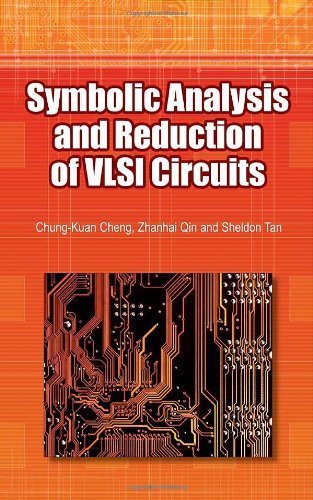
Symbolic Analysis and Reduction of VLSI Circuits

visoft

MyBoerse.bz Pro Member
db3fccd603b1dd83c60f52078da71882.jpeg

Free Download Symbolic Analysis and Reduction of VLSI Circuits by Zhanhai Qin , Sheldon X. D. Tan , Chung-Kuan Cheng
English | PDF | 2005 | 295 Pages | ISBN : 0387239049 | 11.3 MB
Symbolic analysis is an intriguing topic in VLSI designs.​

The analysis methods are crucial for the applications to the parasitic reduction and analog circuit evaluation. However, analyzing circuits symbolically remains a challenging research issue. Therefore, in this book, we survey the recent results as the progress of on-going works rather than as the solution of the field.
For parasitic reduction, we approximate a huge amount of electrical parameters into a simplified RLC network. This reduction allows us to handle very large integrated circuits with given memory capacity and CPU time. A symbolic analysis approach reduces the circuit according to the network topology. Thus, the designer can maintain the meaning of the original network and perform the analysis hierarchically.
For analog circuit designs, symbolic analysis provides the relation between the tunable parameters and the characteristics of the circuit. The analysis allows us to optimize the circuit behavior.
The book is divided into three parts. Part I touches on the basics of circuit analysis in time domain and in s domain. For an s domain expression, the Taylor's expansion with s approaching infinity is equivalent to the time domain solution after the inverse Laplace transform. On the other hand, the Taylor's expansion when s approaches zero derives the moments of the output responses in time domain.
Part II focuses on the techniques for parasitic reduction.
In Chapter 2, we present the approximation methods to match
the first few moments with reduced circuit orders.
In Chapter 3, we apply the Y-Delta transformation to reduce the dynamic linear network. The method finds the exact values of the low order coefficients of the numerator and denominator of the transfer function and thus matches part of the moments. In Chapter 4, we handle two major issues of the Y-Delta
transformation: common factors in fractional expressions and round-off errors. Chapter 5 explains the stability of the reduced expression, in particular the Ruth-Hurwitz Criterion. We make an effort to describe the proof of the Criterion because the details are omitted in most of the contemporary textbooks. In Chapter 6, we present techniques to synthesize circuits to approximate the reduced expressions after the transformation.
In Part III, we discuss symbolic generation of the determinants and cofactors for the application to analog designs. In Chapter 7, we depict the classical topological analysis approach. In Chapter 8, we describe a determinant decision diagram approach that exploits the sparsity of the matrix to accelerate the computation. In Chapter 9, we take only significant terms when we search through
determinant decision diagram to approximate the solution.
In Chapter 10, we extend the determinant decision diagram
to a hierarchical model. The construction of the modules through the hierarchy is similar to the Y-Delta transformation in the sense that a byproduct of common factors appears in the numerator and denominator. Therefore, we describe the method to prune the common factors.
[/b]

Links are Interchangeable - Single Extraction

 
Zurück
Oben Unten