




Measure Corrosion By Electrochemical Impedance Spectroscopy
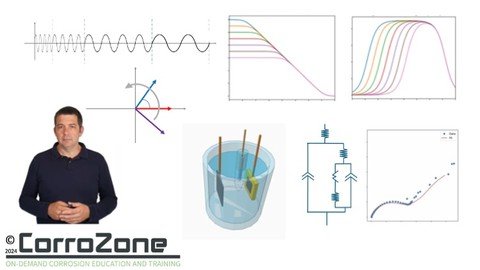
A practical approach to using electrochemical impedance spectroscopy, or EIS, for corrosion measurement and analysis.
What you'll learn
Understand EIS and how it can be used to study corrosion.
Understand processes contributing to EIS response, including polarization resistance, double layer capacitance, and electrolyte resistance.
Understand resistive and capacitive contributions to the EIS response of corroding surfaces.
Learn how to combine impedances in series and parallel.
Learn to measure EIS spectra and understand how corrosion processes affect EIS response shape.
Understand the impact of surface conditions and measurement settings on EIS results.
Learn to select suitable signal amplitude, potential, and frequency, and understand measurement effects on accuracy and time.
Construct and interpret equivalent circuit models for EIS spectra.
Recognize responses of individual circuit components and identify key spectral features.
Learn to fit EIS data using circuit models and extract meaningful insights.
Requirements
Basic understanding of corrosion processes (anodic and cathodic reactions, corrosion current)
Basic understanding of corrosion electrochemistry
Basic understanding of electrical concepts such as voltage, current and resistance
Description
In this course, we will take a practical approach to understanding and using electrochemical impedance spectroscopy (EIS) for corrosion measurement and analysis. We will begin by covering the basics of EIS, discussing essential concepts like impedance, alternating current signals, and corrosion surface phenomena, all aimed at making EIS accessible and straightforward for everyone, and we will finish with a practical example of fitting a complex EIS spectrum.In Section 1, we will learn about the fundamentals of corrosion and impedance in electrochemical systems, building the foundation for understanding how and why EIS is applied to corrosion studies. In Section 2 we will look at how the processes occurring on the surface impact on the EIS responses, considering key factors like polarization resistance, double layer capacitance, and the impact of surface coatings on the EIS response.In Section 3, we will focus on practical considerations for measuring EIS spectra. We will discuss critical topics such as the selection of signal amplitude, the measurement frequency range, and the importance of stationarity to obtain reliable results. Finally, in Section 4, we will learn how to interpret EIS spectra using equivalent circuit models, exploring characteristic responses and fitting techniques to extract valuable information from the data.By the end of the course, we will have the knowledge and skills needed to confidently measure, model, and interpret EIS data for effective corrosion analysis.
Overview
Section 1: Basics of Corrosion and Impedance in Electrochemical Systems
Lecture 1 Introduction to Section 1
Lecture 2 What is electrochemical impedance spectroscopy (EIS)?
Lecture 3 Understanding the corroding surface
Lecture 4 Resistive response of a simple corroding surface and Stern-Geary equation
Lecture 5 Double layer capacitance
Lecture 6 Electrolyte resistance
Lecture 7 Alternating current (AC) signals
Lecture 8 Understanding the concept of impedance
Lecture 9 Connecting impedances in series and in parallel
Lecture 10 Section 1 Summary
Section 2: Surface processes and EIS responses
Lecture 11 Introduction to Section 2
Lecture 12 Measuring the EIS spectrum
Lecture 13 Interactive App: Simulate EIS signal
Lecture 14 Effects of polarization resistance, double layer capacitance, and electrolyte
Lecture 15 Interactive App: Simulate EIS spectrum
Lecture 16 Interactive App: Simulate EIS spectrum (multi-curve)
Lecture 17 Impact of frequency range on resolvable parameters
Lecture 18 Impact of surface layers on EIS response
Lecture 19 Interactive App: Effect of parameters on EIS for surface with layer
Lecture 20 Effect of area and relative area on EIS spectra
Lecture 21 EIS response of a surface supporting a coating with defects
Lecture 22 Interactive App: Effect of relative area of regions with different behaviour.
Lecture 23 Interactive App: Effect of relative area of regions with different behaviour (mu
Lecture 24 Section 2 Summary
Section 3: Practical considerations for the measurement of EIS spectra
Lecture 25 Introduction to Section 3
Lecture 26 Measuring EIS at the corrosion potential
Lecture 27 Influence of signal amplitude on the EIS measurement
Lecture 28 Interactive App: Current response near corrosion potential
Lecture 29 Impact of measurement frequency range on measurement time
Lecture 30 Interactive App: Impact of parameters on measurement time
Lecture 31 Charge passed during EIS measurements
Lecture 32 Interactive App: Thickness of oxidised material
Lecture 33 Requirement of stationarity and noise-related issues
Lecture 34 Section 3 Summary
Section 4: Interpreting EIS spectra using equivalent circuit models and fitting
Lecture 35 Introduction to Section 4
Lecture 36 How fitting works
Lecture 37 Interactive App: Fitting process and error surface
Lecture 38 Characteristic responses of individual equivalent circuit components
Lecture 39 Interactive App: Individual components impedance
Lecture 40 Key features in EIS spectra
Lecture 41 Interactive App: Response of circuit containing a CPE
Lecture 42 Interactive App: Response of circuit containing CPE and Warburg short.
Lecture 43 Constructing an equivalent circuit model
Lecture 44 Practical example of fitting EIS data
Lecture 45 Interactive App: Fitting Example
Lecture 46 Section 4 Summary
Professionals working on corrosion and corrosion testing seeking practical skills to efficiently use EIS for corrosion testing and analysis.,Researchers working on corrosion-related matters looking to gain a deeper understanding of EIS to enhance their corrosion studies and data interpretation skills.,Students approaching the issue of corrosion testing via EIS aiming to build a foundational understanding of EIS to confidently measure, analyze, and interpret corrosion data.
Say "Thank You"
rapidgator.net:
ddownload.com:
Published 10/2024
MP4 | Video: h264, 1920x1080 | Audio: AAC, 44.1 KHz
Language: English | Size: 1.87 GB | Duration: 4h 12m
MP4 | Video: h264, 1920x1080 | Audio: AAC, 44.1 KHz
Language: English | Size: 1.87 GB | Duration: 4h 12m
A practical approach to using electrochemical impedance spectroscopy, or EIS, for corrosion measurement and analysis.
What you'll learn
Understand EIS and how it can be used to study corrosion.
Understand processes contributing to EIS response, including polarization resistance, double layer capacitance, and electrolyte resistance.
Understand resistive and capacitive contributions to the EIS response of corroding surfaces.
Learn how to combine impedances in series and parallel.
Learn to measure EIS spectra and understand how corrosion processes affect EIS response shape.
Understand the impact of surface conditions and measurement settings on EIS results.
Learn to select suitable signal amplitude, potential, and frequency, and understand measurement effects on accuracy and time.
Construct and interpret equivalent circuit models for EIS spectra.
Recognize responses of individual circuit components and identify key spectral features.
Learn to fit EIS data using circuit models and extract meaningful insights.
Requirements
Basic understanding of corrosion processes (anodic and cathodic reactions, corrosion current)
Basic understanding of corrosion electrochemistry
Basic understanding of electrical concepts such as voltage, current and resistance
Description
In this course, we will take a practical approach to understanding and using electrochemical impedance spectroscopy (EIS) for corrosion measurement and analysis. We will begin by covering the basics of EIS, discussing essential concepts like impedance, alternating current signals, and corrosion surface phenomena, all aimed at making EIS accessible and straightforward for everyone, and we will finish with a practical example of fitting a complex EIS spectrum.In Section 1, we will learn about the fundamentals of corrosion and impedance in electrochemical systems, building the foundation for understanding how and why EIS is applied to corrosion studies. In Section 2 we will look at how the processes occurring on the surface impact on the EIS responses, considering key factors like polarization resistance, double layer capacitance, and the impact of surface coatings on the EIS response.In Section 3, we will focus on practical considerations for measuring EIS spectra. We will discuss critical topics such as the selection of signal amplitude, the measurement frequency range, and the importance of stationarity to obtain reliable results. Finally, in Section 4, we will learn how to interpret EIS spectra using equivalent circuit models, exploring characteristic responses and fitting techniques to extract valuable information from the data.By the end of the course, we will have the knowledge and skills needed to confidently measure, model, and interpret EIS data for effective corrosion analysis.
Overview
Section 1: Basics of Corrosion and Impedance in Electrochemical Systems
Lecture 1 Introduction to Section 1
Lecture 2 What is electrochemical impedance spectroscopy (EIS)?
Lecture 3 Understanding the corroding surface
Lecture 4 Resistive response of a simple corroding surface and Stern-Geary equation
Lecture 5 Double layer capacitance
Lecture 6 Electrolyte resistance
Lecture 7 Alternating current (AC) signals
Lecture 8 Understanding the concept of impedance
Lecture 9 Connecting impedances in series and in parallel
Lecture 10 Section 1 Summary
Section 2: Surface processes and EIS responses
Lecture 11 Introduction to Section 2
Lecture 12 Measuring the EIS spectrum
Lecture 13 Interactive App: Simulate EIS signal
Lecture 14 Effects of polarization resistance, double layer capacitance, and electrolyte
Lecture 15 Interactive App: Simulate EIS spectrum
Lecture 16 Interactive App: Simulate EIS spectrum (multi-curve)
Lecture 17 Impact of frequency range on resolvable parameters
Lecture 18 Impact of surface layers on EIS response
Lecture 19 Interactive App: Effect of parameters on EIS for surface with layer
Lecture 20 Effect of area and relative area on EIS spectra
Lecture 21 EIS response of a surface supporting a coating with defects
Lecture 22 Interactive App: Effect of relative area of regions with different behaviour.
Lecture 23 Interactive App: Effect of relative area of regions with different behaviour (mu
Lecture 24 Section 2 Summary
Section 3: Practical considerations for the measurement of EIS spectra
Lecture 25 Introduction to Section 3
Lecture 26 Measuring EIS at the corrosion potential
Lecture 27 Influence of signal amplitude on the EIS measurement
Lecture 28 Interactive App: Current response near corrosion potential
Lecture 29 Impact of measurement frequency range on measurement time
Lecture 30 Interactive App: Impact of parameters on measurement time
Lecture 31 Charge passed during EIS measurements
Lecture 32 Interactive App: Thickness of oxidised material
Lecture 33 Requirement of stationarity and noise-related issues
Lecture 34 Section 3 Summary
Section 4: Interpreting EIS spectra using equivalent circuit models and fitting
Lecture 35 Introduction to Section 4
Lecture 36 How fitting works
Lecture 37 Interactive App: Fitting process and error surface
Lecture 38 Characteristic responses of individual equivalent circuit components
Lecture 39 Interactive App: Individual components impedance
Lecture 40 Key features in EIS spectra
Lecture 41 Interactive App: Response of circuit containing a CPE
Lecture 42 Interactive App: Response of circuit containing CPE and Warburg short.
Lecture 43 Constructing an equivalent circuit model
Lecture 44 Practical example of fitting EIS data
Lecture 45 Interactive App: Fitting Example
Lecture 46 Section 4 Summary
Professionals working on corrosion and corrosion testing seeking practical skills to efficiently use EIS for corrosion testing and analysis.,Researchers working on corrosion-related matters looking to gain a deeper understanding of EIS to enhance their corrosion studies and data interpretation skills.,Students approaching the issue of corrosion testing via EIS aiming to build a foundational understanding of EIS to confidently measure, analyze, and interpret corrosion data.
Screenshots
Say "Thank You"
rapidgator.net:
ddownload.com:
