




MP4 | Video: h264, 1280x720 | Audio: AAC, 44.1 KHz
Language: English | Size: 2.08 GB | Duration: 3h 15m
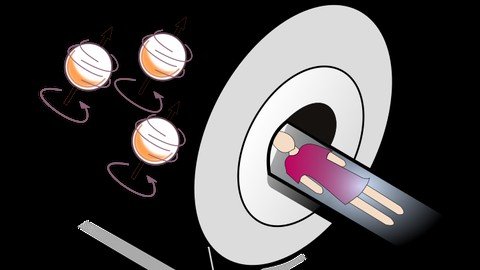
Get a deep understanding of the most versatile medical imaging modality, Magnetic Resonance (MRI) with Python exercises
What you'll learn
Understand what principles the most versatile medical imaging modality, Magnetic Resonance, is based on and how MRI scanners work
Learn how the signal is generated, detected and processed
Learn about the most often used pulse sequences with their parameters, properties and the main contrast types
Learn about RF pulses in depth and how to use and design them in practice
Become familiar with Fourier-based pulse design (hard, sinc, gaussian, hermitte, fermi pulses)
Become familiar with the SLR technique (linear, minimum, maximum, quadratic phase pulses)
Become familiar with adiabatic pulses, slice selective pulses and SpSp pulses
Develop a deeper understanding of how magnetic resonance works from theory to practice
Being able to understand literature and continue learning on your own about MRI
Requirements
Some math knowledge (e.g. knowing exp(x) function, polynomials, fractions, harmonic function etc. ) is beneficial but not strictly required for understanding the majority of the course.
Practical exercises, which are coded in Python, help the deeper understanding of the learnt techniques. Basic Python skills are beneficial here
Description
This course is the first part of an extensive course series about the most versatile medical imaging modality, MRI, and magnetic resonance in general. In the course we are going to discuss what magnetic resonance is and how it works in real life from magnets and coils through spins and tissue parameters to RF pulses and processing tools. The topics aim to give a broad and detailed overview about the principles of both theoretical and practical magnetic resonance as well as cover the vast majority of the RF pulse types and techniques used today. While some math, engineering or science background is definitely beneficial none of these are essential. The course is designed to start from the very basics and gradually reach a level of understanding which can readily be used in practice and extended with self-teaching later on.The course is structured as follows:Introduction - This introductory lecture gives a brief overview about the entirety of magnetic resonance from the physical phenomenon to the signal detection.Signal & Contrast types - MRI is the most versatile medical imaging tool in terms of achievable contrast types and tissue information. This lecture discusses some of the most important ones of these as well as the principles of MR signal generationRelaxation parameters and simple sequences - Here we discuss relaxation in details including how to measure the relaxation time constants and we introduce the pulse acquire and the spin echo pulse sequences and the most often used contrast weightingsDetection and spectra - This session covers the physical principles of signal detection by means of RF coils as well as the main processing of MR, the Fourier-transform. Then we discuss the properties of the resulted complex spectraSteady-state sequences - The fastest and highest SNR yielding sequences are the steady-state sequences. This session gives an extensive overview about their properties, pros and cons as well as the generated signalRF pulse - Introduction - An introductory lecture about the RF pulses in general and more specifically the low flip-angle approximation-based Fourier pulse designRF pulses - SLR design - The lecture introduces the concept of the SLR design as a tool for larger flip-angle pulse design. The different SLR filter types that yield RF pulse types are discussed in detailsRF pulses - Adiabatic pulses - In this section the family of adiabatic pulses are discussed by introducing the principle behind adiabatic rotation and the most often used pulse typesRF pulses with gradient - The last session about RF pulses introduces the topic of slice selection as well as the spectral-spatial pulses for advanced excitationRF coils and the Transmit-Receive chain - The closing lecture of the course gives a broad overview about the path the RF waves traverse from pulse generation to acquired signal processing. The principles of RF coils are also discussed via the example of surface coil building closing the course with some practical tipsQuizzes: Test your knowledge by taking the quizzes at the end of each lesson. If you pass, well done! If you don't, you can review the videos and notes again or ask for help in the Q&A section.Coding exercises: Some of the courses come with coding exercises to help the understanding of the given topic. These are implemented in Python. Probably the easiest way is to run them in VisualStudio Code or Jupyter Notebook. If you have no experience with python neither have a coding environment set up open the files with a text editor and copy paste the content to the online python editor on replit and press run. Please read the comments thoroughly throughout the files as the comments contain instructions and useful information
Overview
Section 1: Introduction
Lecture 1 Introduction
Section 2: Signal&contrast types
Lecture 2 Signal generation
Lecture 3 Contrast types
Section 3: Relaxation times and simple sequences
Lecture 4 Relaxation times and how to measure them
Lecture 5 Simple sequences
Section 4: Detection and spectra
Lecture 6 Detection and spectrum
Lecture 7 Fourier-transform
Lecture 8 Spectra & line shapes
Section 5: Steady-state sequences
Lecture 9 Incoherent steady-state
Lecture 10 Coherent steady-state
Section 6: RF pulses - introduction
Lecture 11 Overview & Fourier design
Section 7: RF pulses - SLR design
Lecture 12 SLR technique
Lecture 13 SLR filter types
Section 8: RF pulses - adiabatic pulses
Lecture 14 Adiabatic pulses - overview & principles
Lecture 15 Adiabatic pulses - frequently used waveforms
Section 9: RF pulses with gradient
Lecture 16 Slice selective RF pulses
Lecture 17 Spatial-Spectral (SpSp) pulses
Section 10: Principles of RF coils and Tx-Rx chain
Lecture 18 RF coils and the Transmit-Receive chain in details
Mainly for those who are interested in or are currently studying magnetic resonance and wish to have a deeper understanding of both the theoretical and the practical aspects.,Everyone who is interested in a cool application of math and science (such background is not strictly required)
Homepage
Recommend Download Link Hight Speed | Please Say Thanks Keep Topic Live
Links are Interchangeable - No Password - Single Extraction
