• Regeln für den Video-Bereich:

    In den Börsenbereich gehören nur Angebote die bereits den Allgemeinen Regeln entsprechen.

    Einteilung

    - Folgende Formate gehören in die angegeben Bereiche:
    - Filme: Encodierte Filme von BluRay, DVD, R5, TV, Screener sowie Telesyncs im Format DivX, XviD und x264.
    - DVD: Filme im Format DVD5, DVD9 und HD2DVD.
    - HD: Encodierte Filme mit der Auflösung 720p oder darüber von BluRay, DVD, R5, TV, Screener sowie Telesyncs im Format x264.
    - 3D: Encodierte Filme von BluRay, die in einem 3D Format vorliegen. Dies gilt auch für Dokus, Animation usw.
    - Serien: Cartoon/Zeichentrick, Anime, Tutorials, Dokumentationen, Konzerte/Musik, Sonstiges sind demnach in die entsprechenden Bereiche einzuordnen, auch wenn sie beispielsweise im High Definition-Format oder als DVD5/DVD9/HD2DVD vorliegen. Ausnahme 3D.
    - Bereich Englisch: Englische Releases gehören immer in diesen Bereich.
    - Bereich Talk: Der Bereich, in dem über die Releases diskutiert werden kann, darf, soll und erwünscht ist.


    Angebot/Beitrag erstellen

    - Ein Beitrag darf erst dann erstellt werden, wenn der Upload bei mindestens einem OCH komplett ist. Platzhalter sind untersagt.
    - Bei einem Scenerelease hat der Threadtitel ausschließlich aus dem originalen, unveränderten Releasenamen zu bestehen. Es dürfen keine Veränderungen wie z.B. Sterne, kleine Buchstaben o.ä. vorgenommen werden. Ausnahme Serienbörse:
    - Bei einem Sammelthread für eine Staffel entfällt aus dem Releasename natürlich der Name der Folge. Beispiel: Die Simpsons S21 German DVDRip XviD - ITG
    - Dementsprechend sind also u.a. verboten: Erweiterungen wie "Tipp", "empfehlenswert", "only", "reup", usw. / jegliche andere Zusatzinformation oder Ergänzung, welche nicht in obiger Beschreibung zu finden ist.

    Aufbau des Angebots und Threadtitel

    Der Titel nach folgendem Muster erstellt zu werden. <Name> [3D] [Staffel] [German] <Jahr> <Tonspur> [DL] [Auflösung] <Quelle> <Codec> - <Group>
    Beispiel: The Dark Knight German 2008 AC3 DVDRip XviD - iND
    Beispiel: The Dark Knight 2008 DTS DL BDRip x264 - iND
    Beispiel: The Dark Knight 2008 AC3 DL BDRip XviD - iND
    Beispiel: The Dark Knight German 2008 AC3 720p BluRay x264 iND
    Beispiel: The Dark Knight 2008 DTS DL 1080p BluRay x264 iND
    Beispiel: Die Simpsons S01 German AC3 DVDRip XviD iND
    Beispiel: Die Simpsons S20 German AC3 720p BluRay x264 iND
    Beispiel: Sword Art Online II Ger Sub 2014 AAC 1080p WEBRip x264 - peppermint
    Entsprechend sind also u.a. verboten: Sonderzeichen wie Klammern, Sterne, Ausrufezeichen, Unterstriche, Anführungszeichen / Erweiterungen wie "Tipp", "empfehlenswert", "only", "reup", usw. / jegliche andere Zusatzinformation oder Ergänzung, welche nicht in obiger Beschreibung zu finden ist
    Ausnahmen hiervon können in den Bereichen geregelt sein.

    Die Beiträge sollen wie folgt aufgebaut werden:
    Überschrift entspricht dem Threadtitel
    Cover
    kurze Inhaltsbeschreibung
    Format, Größe, Dauer sind gut lesbar für Downloader außerhalb des Spoilers zu vermerken
    Nfo sind immer Anzugeben und selbige immer im Spoiler in Textform.
    Sind keine Nfo vorhanden z.B. Eigenpublikationen, sind im Spoiler folgende Dateiinformationen zusätzlich anzugeben :
    Quelle
    Video (Auflösung und Bitrate)
    Ton (Sprache, Format und Bitrate der einzelnen Spuren)
    Untertitel (sofern vorhanden)
    Hosterangabe in Textform außerhalb eines Spoiler mit allen enthaltenen Hostern.
    Bei SD kann auf diese zusätzlichen Dateiinformationen verzichtet werden.

    Alle benötigten Passwörter sind, sofern vorhanden, in Textform im Angebot anzugeben.
    Spoiler im Spoiler mit Kommentaren :"Schon Bedankt?" sind unerwünscht.


    Releases

    - Sind Retail-Release verfügbar, sind alle anderen Variationen untersagt. Ausnahmen: Alle deutschen Retail-Release sind CUT, in diesem Fall sind dubbed UNCUT-Release zulässig.
    - Im Serien-Bereich gilt speziell: Wenn ein Retail vor Abschluss einer laufenden Staffel erscheint, darf diese Staffel noch zu Ende gebracht werden.62
    - Gleiche Releases sind unbedingt zusammenzufassen. Das bedeutet, es ist zwingend erforderlich, vor dem Erstellen eines Themas per Suchfunktion zu überprüfen, ob bereits ein Beitrag mit demselben Release besteht. Ist dies der Fall, ist der bereits vorhandene Beitrag zu verwenden.
    - P2P und Scene Releases dürfen nicht verändert oder gar unter einem iND Tag eingestellt werden.


    Support, Diskussionen und Suche

    - Supportanfragen sind entweder per PN oder im Bereich Talk zu stellen.
    - Diskussionen und Bewertungen sind im Talk Bereich zu führen. Fragen an die Uploader haben ausschließlich via PN zu erfolgen, und sind in den Angeboten untersagt.
    - Anfragen zu Upload-Wünschen sind nur im Bereich Suche Video erlaubt. Antworten dürfen nur auf Angebote von MyBoerse.bz verlinkt werden.


    Verbote

    - Untersagt sind mehrere Formate in einem einzigen Angebotsthread, wie beispielsweise das gleichzeitige Anbieten von DivX/XviD, 720p und 1080p in einem Thread. Pro Format, Release und Auflösung ist ein eigener Thread zu eröffnen.
    - Grundsätzlich ebenso verboten sind Dupes. Uploader haben sich an geeigneter Stelle darüber zu informieren, ob es sich bei einem Release um ein Dupe handelt.
    - Gefakte, nur teilweise lauffähige oder unvollständige Angebote sind untersagt. Dies gilt auch für eigene Publikationen, die augenscheinlich nicht selbst von z.B. einer DVD gerippt wurden. Laufende Serien, bei denen noch nicht alle Folgen verfügbar sind, dürfen erstellt und regelmäßig geupdatet werden.
    - Untersagt sind Angebote, welche nur und ausschließlich in einer anderen Sprache als deutsch oder englisch vorliegen. Ausnahmen sind VORHER mit den Moderatoren zu klären.


    Verstoß gegen die Regeln

    - Angebote oder Beiträge, die gegen die Forenregeln verstoßen, sind über den "Melden"-Button im Beitrag zu melden.
  • Bitte registriere dich zunächst um Beiträge zu verfassen und externe Links aufzurufen.

*** Bestes IPTV *** bester Preis *** gratis Test ***


Master linear algebra Theory and implementation in code

AgentofHeart

MyBoerse.bz Pro Member
537368816_que-es-udemy-analisis-opiniones.jpg

8.47 GB | 29min 0s | mp4 | 1920X1080 | 16:9
Genre:eLearning |Language:English


2941727592d6008edf46ef09cca58875.jpg

Master linear algebra: theory and implementation in code
2026-02-28
MP4 | Video: h264, 1920x1080 | Audio: AAC, 44.1 KHz
Language: English (US) | Size: 8.55 GB | Duration: 33h 45m​

Learn concepts in linear algebra and matrix analysis, and implement them in MATLAB and Python.

What you'll learn
Understand theoretical concepts in linear algebra, including proofs
Implement linear algebra concepts in scientific programming languages (MATLAB, Python)
Apply linear algebra concepts to real datasets
Ace your linear algebra exam!
Apply linear algebra on computers with confidence
Gain additional insights into solving problems in linear algebra, including homeworks and applications
Be confident in learning advanced linear algebra topics
Understand some of the important maths underlying machine learning
The math underlying most of AI (artificial intelligence)

Requirements
Basic understanding of high-school algebra (e.g., solve for x in 2x=5)
Interest in learning about matrices and vectors!
(optional) Computer with MATLAB, Octave, or Python (or Jupyter)

Description
You need to learn linear algebra!Linear algebra is perhaps the most important branch of mathematics for computational sciences, including machine learning, AI, data science, statistics, simulations, computer graphics, multivariate analyses, matrix decompositions, signal processing, and so on.You need to know applied linear algebra, not just abstract linear algebra!The way linear algebra is presented in 30-year-old textbooks is different from how professionals use linear algebra in computers to solve real-world applications in machine learning, data science, statistics, and signal processing. For example, the "determinant" of a matrix is important for linear algebra theory, but should you actually use the determinant in practical applications? The answer may surprise you, and it's in this course!If you are interested in learning the mathematical concepts linear algebra and matrix analysis, but also want to apply those concepts to data analyses on computers (e.g., statistics or signal processing), then this course is for you! You'll see all the maths concepts implemented in MATLAB and in Python.Unique aspects of this courseClear and comprehensible explanations of concepts and theories in linear algebra.Several distinct explanations of the same ideas, which is a proven technique for learning.Visualization using graphs, numbers, and spaces that strengthens the geometric intuition of linear algebra.Implementations in MATLAB and Python. Com'on, in the real world, you never solve math problems by hand! You need to know how to implement math in software!Beginning to intermediate topics, including vectors, matrix multiplications, least-squares projections, eigendecomposition, and singular-value decomposition.Strong focus on modern applications-oriented aspects of linear algebra and matrix analysis.Intuitive visual explanations of diagonalization, eigenvalues and eigenvectors, and singular value decomposition.Improve your coding skills! You do need to have a little bit of coding experience for this course (I do not teach elementary Python or MATLAB), but you will definitely improve your scientific and data analysis programming skills in this course. Everything is explained in MATLAB and in Python (mostly using numpy and matplotlib; also sympy and scipy and some other relevant toolboxes).Benefits of learning linear algebraUnderstand statistics including least-squares, regression, and multivariate analyses.Improve mathematical simulations in engineering, computational biology, finance, and physics.Understand data compression and dimension-reduction (PCA, SVD, eigendecomposition).Understand the math underlying machine learning and linear classification algorithms.Deeper knowledge of signal processing methods, particularly filtering and multivariate subspace methods.Explore the link between linear algebra, matrices, and geometry.Gain more experience implementing math and understanding machine-learning concepts in Python and MATLAB.Linear algebra is a prerequisite of machine learning and artificial intelligence (A.I.).Why I am qualified to teach this course:I have been using linear algebra extensively in my research and teaching (in MATLAB and Python) for many years. I have written several textbooks about data analysis, programming, and statistics, that rely extensively on concepts in linear algebra. So what are you waiting for??Watch the course introductory video and free sample videos to learn more about the contents of this course and about my teaching style. If you are unsure if this course is right for you and want to learn more, feel free to contact with me questions before you sign up.I hope to see you soon in the course!Mike

Who this course is for:
Anyone interested in learning about matrices and vectors, Students who want supplemental instruction/practice for a linear algebra course, Engineers who want to refresh their knowledge of matrices and decompositions, Biologists who want to learn more about the math behind computational biology, Data scientists (linear algebra is everywhere in data science!), Statisticians, Someone who wants to know the important math underlying machine learning, Someone who studied theoretical linear algebra and who wants to implement concepts in computers, Computational scientists (statistics, biological, engineering, neuroscience, psychology, physics, etc.), Someone who wants to learn about eigendecomposition, diagonalization, and singular value decomposition!, Artificial intelligence students

For More Courses Visit & Bookmark Your Preferred Language Blog
From Here: - - - - - - - -


6ZULP8oZ_o.jpg


755954235_yxusj-41209nwbx2nj.jpg

Master linear algebra: theory and implementation in code
2026-02-28
MP4 | Video: h264, 1920x1080 | Audio: AAC, 44.1 KHz
Language: English (US) | Size: 8.55 GB | Duration: 33h 45m​

What you'll learn
Understand theoretical concepts in linear algebra, including proofs
Implement linear algebra concepts in scientific programming languages (MATLAB, Python)
Apply linear algebra concepts to real datasets
Ace your linear algebra exam!
Apply linear algebra on computers with confidence
Gain additional insights into solving problems in linear algebra, including homeworks and applications
Be confident in learning advanced linear algebra topics
Understand some of the important maths underlying machine learning
The math underlying most of AI (artificial intelligence)

Requirements
Basic understanding of high-school algebra (e.g., solve for x in 2x=5)
Interest in learning about matrices and vectors!
(optional) Computer with MATLAB, Octave, or Python (or Jupyter)

Description
You need to learn linear algebra!Linear algebra is perhaps the most important branch of mathematics for computational sciences, including machine learning, AI, data science, statistics, simulations, computer graphics, multivariate analyses, matrix decompositions, signal processing, and so on.You need to know applied linear algebra, not just abstract linear algebra!The way linear algebra is presented in 30-year-old textbooks is different from how professionals use linear algebra in computers to solve real-world applications in machine learning, data science, statistics, and signal processing. For example, the "determinant" of a matrix is important for linear algebra theory, but should you actually use the determinant in practical applications? The answer may surprise you, and it's in this course!If you are interested in learning the mathematical concepts linear algebra and matrix analysis, but also want to apply those concepts to data analyses on computers (e.g., statistics or signal processing), then this course is for you! You'll see all the maths concepts implemented in MATLAB and in Python.Unique aspects of this courseClear and comprehensible explanations of concepts and theories in linear algebra.Several distinct explanations of the same ideas, which is a proven technique for learning.Visualization using graphs, numbers, and spaces that strengthens the geometric intuition of linear algebra.Implementations in MATLAB and Python. Com'on, in the real world, you never solve math problems by hand! You need to know how to implement math in software!Beginning to intermediate topics, including vectors, matrix multiplications, least-squares projections, eigendecomposition, and singular-value decomposition.Strong focus on modern applications-oriented aspects of linear algebra and matrix analysis.Intuitive visual explanations of diagonalization, eigenvalues and eigenvectors, and singular value decomposition.Improve your coding skills! You do need to have a little bit of coding experience for this course (I do not teach elementary Python or MATLAB), but you will definitely improve your scientific and data analysis programming skills in this course. Everything is explained in MATLAB and in Python (mostly using numpy and matplotlib; also sympy and scipy and some other relevant toolboxes).Benefits of learning linear algebraUnderstand statistics including least-squares, regression, and multivariate analyses.Improve mathematical simulations in engineering, computational biology, finance, and physics.Understand data compression and dimension-reduction (PCA, SVD, eigendecomposition).Understand the math underlying machine learning and linear classification algorithms.Deeper knowledge of signal processing methods, particularly filtering and multivariate subspace methods.Explore the link between linear algebra, matrices, and geometry.Gain more experience implementing math and understanding machine-learning concepts in Python and MATLAB.Linear algebra is a prerequisite of machine learning and artificial intelligence (A.I.).Why I am qualified to teach this course:I have been using linear algebra extensively in my research and teaching (in MATLAB and Python) for many years. I have written several textbooks about data analysis, programming, and statistics, that rely extensively on concepts in linear algebra. So what are you waiting for??Watch the course introductory video and free sample videos to learn more about the contents of this course and about my teaching style. If you are unsure if this course is right for you and want to learn more, feel free to contact with me questions before you sign up.I hope to see you soon in the course!Mike

Who this course is for:
Anyone interested in learning about matrices and vectors, Students who want supplemental instruction/practice for a linear algebra course, Engineers who want to refresh their knowledge of matrices and decompositions, Biologists who want to learn more about the math behind computational biology, Data scientists (linear algebra is everywhere in data science!), Statisticians, Someone who wants to know the important math underlying machine learning, Someone who studied theoretical linear algebra and who wants to implement concepts in computers, Computational scientists (statistics, biological, engineering, neuroscience, psychology, physics, etc.), Someone who wants to learn about eigendecomposition, diagonalization, and singular value decomposition!, Artificial intelligence students

For More Courses Visit & Bookmark Your Preferred Language Blog
From Here: - - - - - - - -


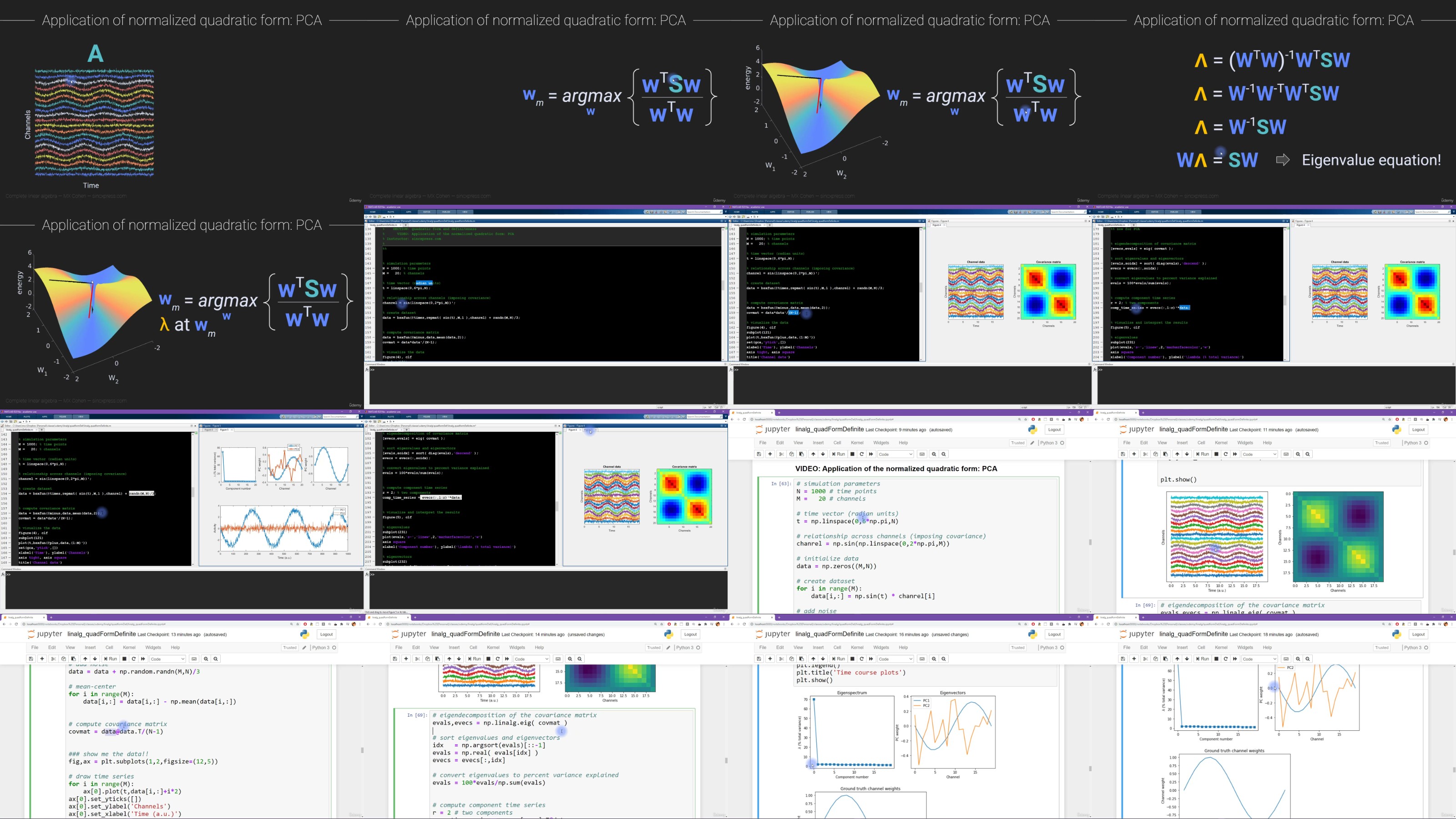
yxusj-6-Application-of-the-normalized-quadratic-form-PCA.jpg

755954260_yxusj-2om782zi28qe.jpg

 
Zurück
Oben Unten